
The Rise of Tokenized Real-World Assets: An Emerging Trend Disrupting Finance and Beyond
Tokenization of real-world assets (RWAs) is gaining traction as a weak signal that could evolve into a major disruptive trend across finance, legal frameworks, supply chain, and broader economic systems over the next decade. While blockchain and cryptocurrencies have captivated attention for years, the shift toward representing tangible assets—such as real estate, securities, and commodities—on digital ledgers may transform how value is stored, traded, and regulated. This article explores recent developments that point to this trend’s acceleration, its potential systemic impacts, and the strategic considerations critical for businesses, governments, and investors.
What’s Changing?
Tokenization refers to the digital representation of ownership of a physical or non-digital asset on a blockchain or similar distributed ledger technology (DLT). It enables fractional ownership, greater liquidity, automated governance, and transparency. While the concept has existed in niche sectors, 2025-2026 may mark a tipping point, triggered by regulatory clarity, institutional adoption, and technological maturation.
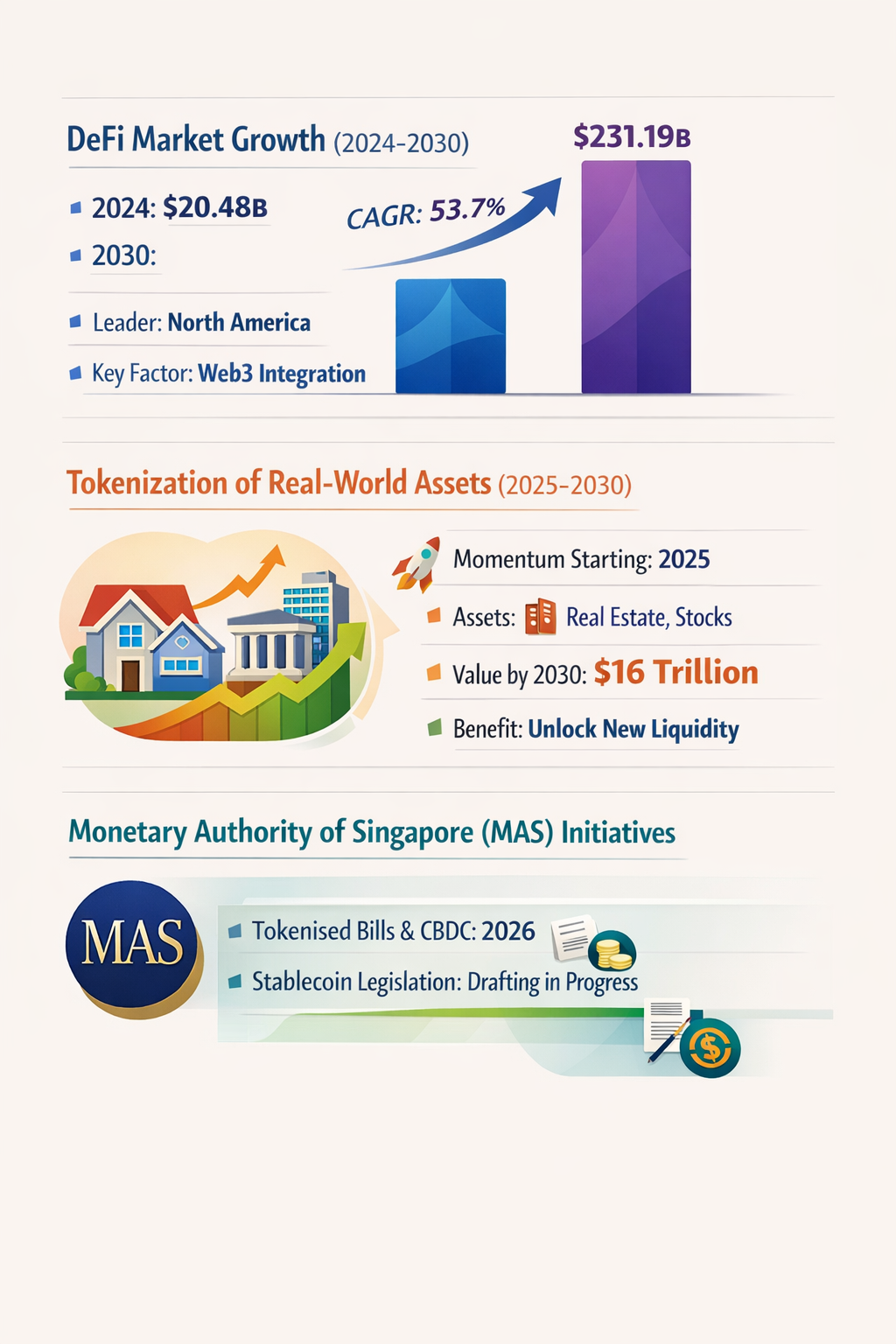
Analysts predict the total value of tokenized assets could exceed $10 trillion by 2030, driven by factors such as increased transparency, automation through smart contracts, and improved liquidity for traditionally illiquid assets like real estate and fine art (Big News Network). DeFi (decentralized finance) platforms have already begun integrating RWAs into their ecosystems, unlocking new pools of liquidity and attracting institutional investors who have typically shunned crypto markets due to volatility and regulatory uncertainty (Post-Gazette).
Central banks and regulatory bodies are also progressively engaging with the tokenization ecosystem, recognizing its potential to reshape monetary policy and market infrastructure. The Monetary Authority of Singapore, for instance, plans to issue tokenized treasury bills settled with central bank digital currency (CBDC) and is drafting legislation specific to stablecoins and tokenized assets (Central Banking).
Regarding stablecoins, their mainstream adoption in 2025 sets the foundation for more complex tokenized assets issuance in 2026 and beyond, facilitating programmable and interoperable financial products that could redefine cross-border payments and FX corridors (Hipther). Regulatory sandboxes, such as those launched by the UK Financial Conduct Authority (FCA), are enabling experimentation with stablecoins and tokenized assets in controlled environments to foster innovation while managing risk (FCA).
Smart contracts, which embed legal or operational rules into programmable code, are expected to see widespread adoption in contract execution and asset management by 2025. This development may underpin tokenized asset transactions, automating compliance and settlement, thus reducing counterparty risks and overhead (Yellow.com).
All these factors form an interconnected set of changes that could accelerate the tokenization trend into mainstream markets, transforming not just trading but asset ownership frameworks themselves.
Why Is This Important?
The tokenization of RWAs could disrupt multiple industries and reshape the global financial ecosystem by:
- Democratizing access: Fractional ownership lowers the barriers to investing in high-value assets like real estate, art, and infrastructure projects that were previously accessible mainly to wealthy individuals or institutions.
- Increasing liquidity: Illiquid assets become tradable 24/7 on secondary markets powered by blockchain, enabling quicker capital recycling and enhanced price discovery.
- Automating governance and compliance: Smart contracts streamline legal enforcement, dividend payments, audits, and regulatory reporting, reducing operational costs and errors.
- Facilitating cross-border transactions: Interoperable tokens and stablecoins could create programmable foreign exchange corridors, simplifying international investments and payments.
- Reducing counterparty risks and fraud: Transparency inherent in distributed ledgers may reduce opacity and manipulation in asset markets.
These changes do not just affect financial services. The legal profession may face transformative shifts as contracts and property registry migrate to code-based digital forms. Supply chain management could also benefit from tokenizing physical goods, improving traceability and ownership tracking.
However, the systemic risks cannot be overlooked. The surge of stablecoins and tokenized assets without coordinated regulation could create new fragilities in the financial system (CoinDesk). Interoperability challenges, privacy concerns, and market manipulation are potential pitfalls. These issues demand novel regulatory frameworks and international cooperation.
Implications
For businesses, governments, and investors, the rise of tokenized assets suggests several key strategic implications:
- Regulatory preparedness: Stakeholders should monitor developments in legislation and engage proactively with regulators to shape frameworks that balance innovation with risk management.
- Investment strategies: Financial institutions might need to expand their infrastructure capabilities to support tokenized asset custody, trading, and settlement while reassessing portfolio diversification strategies.
- Legal and operational transformations: Legal firms and compliance units should begin developing expertise in smart contract auditing, digital identity verification, and DLT governance models.
- Technology adoption: Organizations should explore blockchain platforms that support tokenization standards and interoperability, investing in pilot projects within regulatory sandboxes (FCA).
- Cross-sector collaboration: A multisector alliance involving finance, technology, legal, and regulatory bodies could address standardization challenges and create shared infrastructure for tokenized asset markets.
From a macroeconomic perspective, the tokenization wave might influence capital formation, monetary policy, and even economic inequality patterns by altering who can invest and how assets circulate.
Questions
- How will existing regulatory regimes adapt to the challenges posed by tokenized real-world assets, and what frameworks will be necessary for international harmonization?
- What risks emerge around liquidity mismatches if tokenized markets grow faster than regulatory oversight?
- How might tokenization influence the role and power of traditional financial intermediaries like banks, brokers, and custodians?
- What new legal standards must be developed for smart contract enforceability and dispute resolution in tokenized asset transactions?
- How can organizations balance privacy with transparency, especially when tokenization intersects with personal data or sensitive commercial information?
These strategic questions underline the need for horizon scanning that integrates legal, technological, and economic perspectives to anticipate how tokenized real-world assets might reshape systems in both expected and unforeseen ways.
Keywords
tokenization; real world assets; stablecoins; decentralized finance; smart contracts; central bank digital currency; regulatory sandbox; blockchain interoperability
Bibliography
- In 2025, smart contracts are predicted to see widespread adoption in legal agreements, supply chain management, and corporate operations. Yellow.com.
- The Rise of Tokenized Real-World Assets: How Brokers are Preparing for the Next Wave of Institutional Money. Big News Network.
- Tokenization of Real-World Assets gains momentum in 2025 supported by DeFi platforms. Post-Gazette.
- MAS to issue tokenized bills and draft stablecoin law. Central Banking.
- Interoperability with global stablecoins: emergent programmable FX corridors. Hipther.
- FCA outlines stablecoin payments priority for 2026 and regulatory sandbox initiatives. FCA.
- Surge of stablecoins worldwide poses systemic risks without international regulatory coordination. CoinDesk.