
Beyond 6G and LEO: The Quiet Rise of Satellite-Enabled Multi-Radio Meshes as a Structural Disruptor in Connectivity
Emerging satellite direct-to-device communication combined with multi-radio access technology sharing signals a potentially transformative shift in global connectivity architecture. This weak signal suggests a future where terrestrial and non-terrestrial networks converge into dynamic, resilient radio meshes. Such systems could recalibrate capital flows, prompt new regulatory paradigms, and restructure competitive dynamics across telecom, satellite, and technology sectors over the next two decades.
While the connectivity discourse today is dominated by the 5G to 6G transition and the proliferation of Low Earth Orbit (LEO) satellite constellations like Starlink and China’s similar initiatives, an under-recognized development is the integration of satellite direct-to-device communication with advanced multi-radio access technologies (RAT) and spectrum sharing. This convergence points toward an inflection in network design — beyond incremental speed and coverage gains — toward a layered, flexible, and autonomous intelligent fabric in connectivity.
Signal Identification
This development qualifies as an emerging inflection indicator rather than mere hype or noise. It elevates beyond incremental innovation by introducing a systemic shift in how connectivity layers are architected and orchestrated globally. The signal timeline plausibly spans 10–20 years with a medium-to-high plausibility band given ongoing industry collaboration and national strategic programs. Key sectors exposed include telecommunications, satellite internet, spectrum regulation, IoT ecosystems, and cybersecurity.
What Is Changing
Firstly, 6G standards are being co-designed with satellite direct-to-device capabilities embedded at their core, notably through New Radio Non-Terrestrial Networks (NR NTN) extensions. Ericsson highlights that 6G aims to introduce Global Navigation Satellite System (GNSS)-independent operations for resilience, while enabling spectrum sharing for smooth migration across terrestrial and space-based networks (Ericsson 17/03/2026). This reflects a purposeful departure from treating satellite internet as a standalone overlay toward integrated multi-radio access technology (RAT) environments.
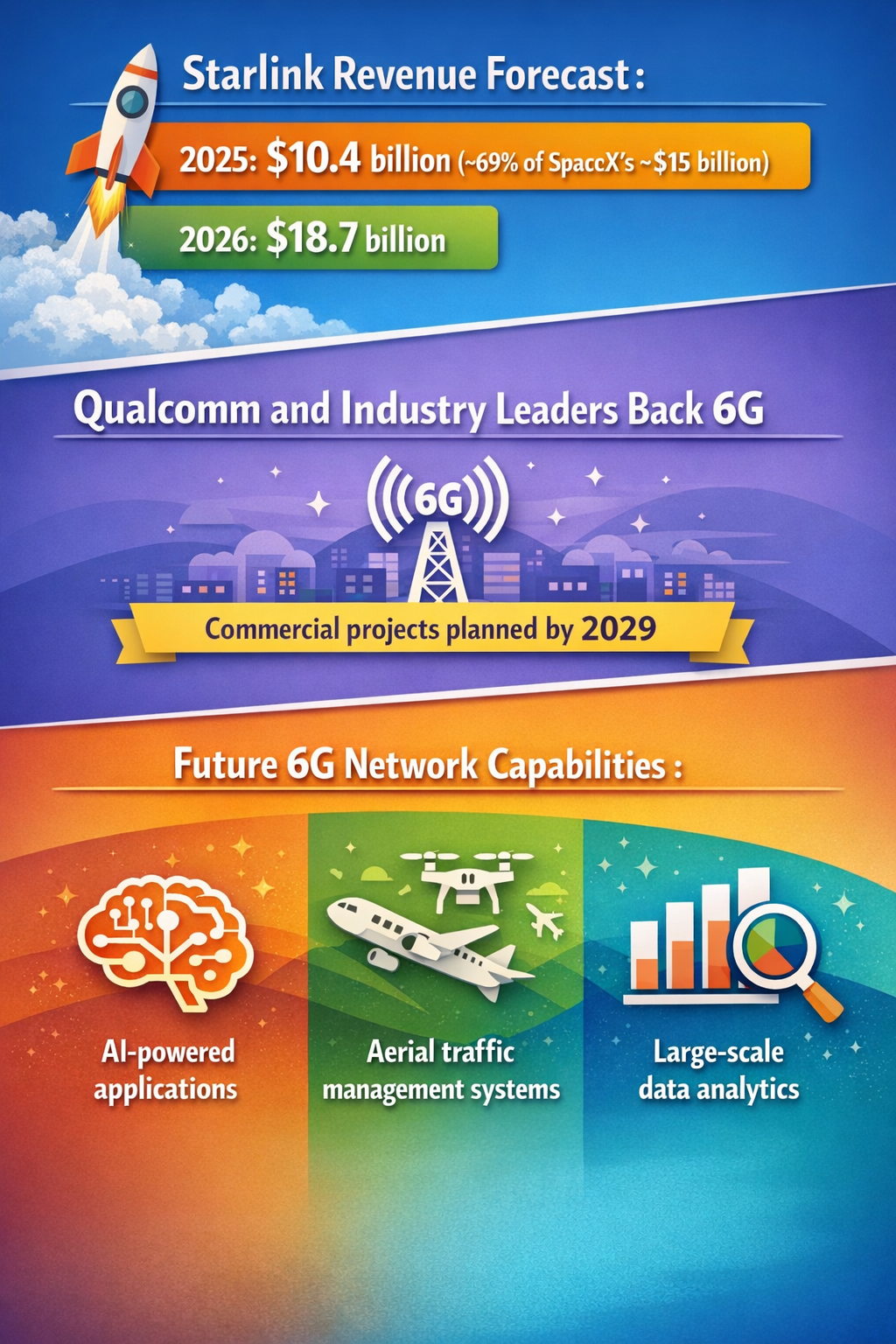
Secondly, extensive deployment plans of LEO constellations by actors such as SpaceX’s Starlink (with over 12,000 satellites operational and filings for 42,000 more) and China’s nationally coordinated mega-constellation ambitions highlight the increasing scale and strategic intent of satellite internet (CGTN 15/03/2026; Onoff 04/02/2026). Revenues from Starlink alone are growing rapidly, evidencing broadening commercial viability (Orbital Radar 10/02/2026).
Thirdly, IoT proliferation—projected to reach 20.1 billion connected devices by 2026—and the concomitant rise in cybersecurity mesh demand indicates an urgent need for adaptable, high-resilience network topologies (Esparkinfo 07/01/2026; Persistence Market Research 11/03/2026). Multi-radio, multi-access networks incorporating terrestrial towers, local IoT mesh nodes, and direct satellite links could provide unprecedented scalability and security.
Finally, industrial coalitions like the Ericsson-Qualcomm-T-Mobile consortium shaping 6G commercialization targets embed multi-radio and satellite technologies into their milestone-driven roadmap for post-2029 networks (T-Mobile 12/03/2026; Investing News 05/03/2026).
The substantive structural theme is the rise of an intelligent fabric: a mesh of multi-radio access technologies that integrates terrestrial 5G/6G networks with direct satellite-to-device links into a dynamic, autonomously managed connectivity ecosystem. This fundamentally changes the topology, resilience, and governance of global communication infrastructure.
Disruption Pathway
The pathway to widespread adoption of integrated satellite-terrestrial multi-radio mesh networks begins with continued standardization and techno-commercial validation of NR NTN capabilities within 6G development cycles. Increasing scale of satellite constellations and enhanced direct-to-device satellite technologies provide essential physical-layer enablers.
Acceleration conditions include accelerated regulatory adaptation allowing spectrum sharing between terrestrial and satellite operators, growth of low-latency and AI-powered network management systems to orchestrate mesh handoffs, and industrial coalitions advancing interoperable hardware and software standards. The burgeoning IoT landscape—with vast numbers of mobile, often remote devices—may stress current network architectures, demanding more resilient and multi-access solutions.
Existing cellular incumbents could face stresses as integrated satellite links offload traffic and extend coverage into traditionally underserved or difficult terrains. Satellite operators may shift from pure wholesale bandwidth providers to primary connectivity players owning end-user relationships. Spectrum regulators will be challenged to define frameworks that balance terrestrial and satellite operators, potentially forcing radical reforms in spectrum licensing and interference management policies.
Structural adaptations might include the rise of new multi-access network operators or “connectivity integrators” specialized in orchestrating intelligent fabrics. Governance models could decentralize, with machine-driven dynamic spectrum allocation supplanting legacy fixed allocations. Feedback loops whereby increased resilience and network ubiquity accelerate IoT and AI application adoption may further entrench the shift.
Unintended consequences might include exacerbated space debris concerns due to massive satellite constellations and complex interference environments if coordination mechanisms lag technological capabilities. However, the strategic imperative of connectivity resilience in geopolitical and climate uncertainty contexts could catalyze long-term commitment toward such integrated networks.
Why This Matters
For capital allocators, this signal may herald a shift in investment flows away from linear cellular infrastructure buildouts toward hybrid terrestrial-satellite platforms, related AI-driven orchestration systems, and cybersecurity mesh frameworks. Early positioning in multi-radio access hardware and software ecosystems could yield competitive advantages.
Regulators face the challenge of overhauling spectrum licensing frameworks to accommodate seamless sharing between terrestrial and satellite technologies, possibly transcending national boundaries and requiring new multilateral governance architectures. Liability models may evolve as network ownership and control diffuse, influencing cybersecurity and service-level responsibility.
From an industrial strategy perspective, incumbent telecom operators need to redefine competitive postures, potentially collaborating with satellite providers or risk disintermediation. Supply chains integrating satellite fabrication, launch logistics, terrestrial radio infrastructure, and AI software will intertwine, shifting traditional industrial boundaries.
Implications
This development could plausibly transform global connectivity from predominantly terrestrial-centric cellular networks into a distributed, multi-radio intelligent fabric where satellite links serve as equal partners rather than niche complementary services. Such structural change might catalyze new business models based on on-demand, location-agnostic connectivity resilience and latency robustness.
It is unlikely that this will be a short-term incremental upgrade or solely a space industry story. Instead, the fusion across terrestrial and non-terrestrial domains may reconfigure regulatory, capital, and operational frameworks in a manner comparable to the earlier cellular voice-to-data paradigm shift. The transition could be uneven across regions, further influencing global digital divides.
Competing interpretations might consider satellite direct-to-device as a supplementary fallback rather than a mainstream connectivity mode. However, the emerging coalition standards and strategic industrial roadmaps suggest a bolder integration beyond fallback scenarios.
Early Indicators to Monitor
- Release and adoption rates of 6G standards incorporating NR NTN and multi-radio spectrum sharing mechanisms.
- Regulatory policy drafts enabling dynamic, cross-domain spectrum sharing between satellite and terrestrial operators.
- Venture funding rounds in AI orchestration platforms for multi-radio intelligent network fabrics.
- Procurement and commercial deployment announcements by major telecom operators integrating satellite direct-to-device capability.
- Patent filings on seamless handover algorithms and cross-radio access technology interoperability.
Disconfirming Signals
- Persistent regulatory fragmentation or reluctance to enable flexible spectrum sharing between terrestrial and satellite services.
- Technological limitations or escalating interference issues that destabilize multi-radio mesh reliability.
- Slower-than-expected commercial viability of satellite direct-to-device services, with incumbent reliance remaining on terrestrial 5G/6G exclusivity.
- Geopolitical disruptions impeding global satellite constellation deployments and cross-border interoperability.
- Emergence of alternative disruptive connectivity technologies (e.g., pervasive quantum communication) eclipsing radio-based convergence.
Strategic Questions
- How should capital allocation strategies evolve to capture value in converged terrestrial-satellite multi-radio networks?
- What regulatory frameworks can balance spectrum efficiency, innovation incentives, and sovereignty concerns in an integrated connectivity fabric?
Keywords
Satellite Direct-to-Device; New Radio Non-Terrestrial Networks; 6G; Multi-Radio Access Technology; Low Earth Orbit Constellations; IoT Mesh Networks; Spectrum Sharing; Connectivity Fabric; Cybersecurity Mesh; Space Regulation
Bibliography
- Building on the strong foundation of New Radio NTN, 6G will introduce advanced capabilities such as Global Navigation Satellite System-independent operation for increased resilience and multi-radio access technology spectrum sharing for smooth migration. Ericsson Technology Review. Published 17/03/2026.
- China will continue constructing a large satellite internet constellation, coordinated at the national level. CGTN. Published 15/03/2026.
- SpaceX alone plans over 12,000 Starlink satellites, with applications filed for 42,000 more. Onoff. Published 04/02/2026.
- There will be 20.1 billion connected IoT devices by 2026. Esparkinfo. Published 07/01/2026.
- With rising number of IoT devices around the world, demand for cyber security mesh is projected to increase by 2032. Persistence Market Research. Published 11/03/2026.
- Qualcomm Technologies and T-Mobile will continue their close collaboration toward 6G commercialization targeted for 2029, while building on the momentum of 5G Advanced deployments. T-Mobile Newsroom. Published 12/03/2026.
- Ericsson is participating in a strategic industry coalition with Qualcomm, announced at MWC, that sets a milestone-driven roadmap toward 6G commercial systems starting from 2029 onwards. Investing News. Published 05/03/2026.
- SpaceX's Starlink generated an estimated $10.4 billion in 2025 (~69% of SpaceX's ~ $15 billion total revenue) and is projected to reach $18.7 billion in 2026. Orbital Radar. Published 10/02/2026.