
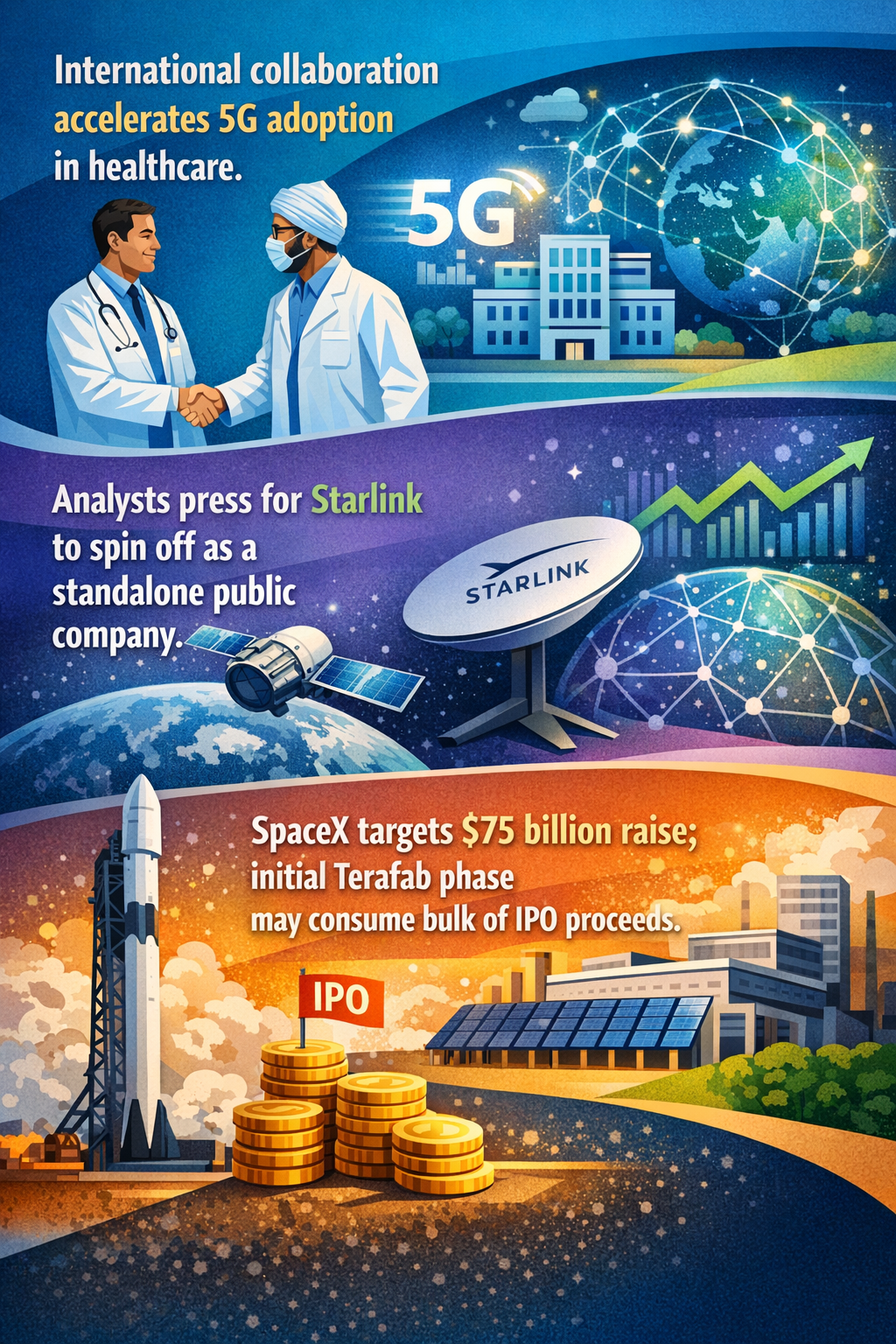
Space-Based Satellite Internet Constellations as an Underappreciated Inflection in Global Connectivity
Emerging satellite mega-constellations may fundamentally disrupt global connectivity infrastructure, challenging terrestrial network paradigms and regulatory frameworks. This paper surfaces the under-recognized trajectory of space-based internet as a structural inflection that could reshape capital allocation, competition, and governance over the next two decades.
The proliferation of satellite internet constellations, exemplified by SpaceX’s Starlink, is widely noted for expanding broadband access to underserved regions. Yet, a less obvious but structurally significant development lies in the integration of space-based and terrestrial mobile networks, creating hybrid connectivity ecosystems capable of redefining access models, spectrum management, and competitive dynamics. Coupled with advances in launch technology and material sciences for 6G networks, these hybrid architectures are poised to disrupt incumbent telecom and regulatory paradigms by 2030 and beyond.
Signal Identification
This development qualifies as an emerging inflection indicator. It moves beyond a discrete growth trend in satellite internet users toward an integrated hybrid connectivity paradigm that could transform network architecture, spectrum use, and industry structure over a 10–20 year horizon. The plausibility band is medium to high given current technological progress in satellite manufacturing, launch capabilities, and early market integration moves by telecommunications providers.
Key sectors exposed include telecommunications, internet service provision, defense, aerospace manufacturing, regulatory institutions, and digital infrastructure investment. The signal is underappreciated in foresight discourse because much attention remains siloed on terrestrial 5G/6G or on satellite internet as a niche for rural areas rather than a mainstream, multi-modal network layer essential to future connectivity ecosystems.
What Is Changing
Satellite internet constellations are scaling rapidly: Starlink alone comprises thousands of satellites, with speeds currently ranging between 100 and 400 Mbps for residential users in the U.S. (SatelliteInternet.com 20/04/2024). The upcoming Starship launch vehicle promises to dramatically reduce deployment costs and increase constellation replenishment frequency, accelerating network scalability (SpaceDaily 05/05/2024). This signals a step change not only in capacity but also in network resilience and geographic reach.
Simultaneously, major telecom providers including US Mobile are piloting bundled offers that combine terrestrial 5G with Starlink satellite internet for a seamless customer experience (The Art of CTO 10/04/2024). This integration heralds a hybrid network architecture paradigm—blurring lines between satellite and mobile network services—and suggests future mobile connectivity may no longer be earthbound-centric.
Material innovations driving lower-loss components for 6G telecommunications system components are progressing in parallel, targeting rollout around 2030 (IDTechEx 15/03/2024). The confluence of space-based internet with evolving terrestrial standards may allow hybrid 5G/6G networks extending coverage ubiquitously, including to highly urbanized and remote environments, reinforcing uneven adoption patterns noted by ITU and GSMA projections (Global Business Outlook 25/02/2024).
According to recent investment and market growth analyses, Asia Pacific markets—including India—are rapidly adopting IoT and broadband connectivity, embedding hybrid connectivity imperatives into their industrial modernization efforts (GetInsights360 01/04/2024). These forces imply that space-enabled hybrid networks may shift from marginal service to central role in national digital strategies.
Disruption Pathway
The decline in launch costs enabled by Starship launches and material advances for 6G may accelerate satellite constellation deployment, driving network capacity and coverage expansion at a scale surpassing terrestrial infrastructure investments. This availability is a critical enabler for telecom providers to integrate satellite layers into core service offerings rather than treating satellite internet as a niche or fallback option.
Existing telecommunications incumbents face pressure as hybrid satellite-terrestrial services threaten to commoditize localized terrestrial towers, challenging legacy capital expenditure and spectrum allocation models. Hybrid models may demand new standards for seamless handoff between satellite and terrestrial nodes, spectrum sharing agreements, and digital identity provisioning across network types.
Regulatory frameworks built around geofenced licenses and fixed infrastructure may be strained by fluid satellite coverage that overlaps multiple jurisdictions simultaneously. This could precipitate systemic changes in international coordination bodies like the International Telecommunication Union (ITU), and force reconsideration of cross-border data governance and cyber risk policies linked to space-based infrastructure.
Feedback loops may emerge wherein reduced rural coverage gaps increase digital ecosystem growth, incentivizing further investment in satellite manufacturing, launch capacity, and in integrated network software platforms. Conversely, concerns related to orbital congestion, collision risk, and astronomical light pollution could provoke pushback imposing constraints on constellation scale, thus heightening geopolitical contestation over orbital commons.
Collectively, these factors may reshape power dynamics among traditional terrestrial telecom operators, new space actors, and regulators, producing an industrial reconfiguration that privileges scale, integrated multimodal services, and agility over legacy hardware-bound models.
Why This Matters
Capital allocation decisions may face a growing imperative to balance investment between traditional terrestrial 5G/6G infrastructure and satellite constellation ventures. Overcommitting to one at the exclusion of the hybrid evolutionary trajectory risks stranded assets or competitive disadvantage. Multinational telecom operators need to rethink strategic positioning vis-à-vis satellite-as-a-service providers.
For regulators, anticipating and shaping frameworks around shared spectrum use, cross-border satellite governance, and hybrid network cybersecurity may become priorities. Liability regimes tied to collision risks or service outages due to satellite failures require updating. National security strategies will need to address space-based connectivity as critical infrastructure, influencing industrial policy and defense collaboration.
The nascent satellite internet ecosystem’s reliance on new materials, launch providers, and component manufacturers underscores potential supply chain risks and opportunities. Countries fostering domestic capabilities in these domains may gain strategic advantages, influencing industrial policy and international trade relations.
Implications
Hybrid satellite-terrestrial connectivity networks likely will become foundational infrastructure by 2030, not merely an alternative or complementary service. This transition may transform competitive dynamics, regulatory oversight, and network design standards globally.
This signal is not simply incremental growth of satellite broadband access or speculations on 6G alone. It reflects a systemic recombination of network modalities enabled through technological and launch cost breakthroughs.
Alternative interpretations may view satellite internet as perpetually complementing terrestrial coverage rather than integrating fully; or foresee regulatory inertia preventing effective hybrid market formation. However, investment trends, market pilots, and material development trajectories indicate rising medium-term plausibility.
Early Indicators to Monitor
- Patent filings on hybrid terrestrial-satellite network handoff protocols and integrated SIM/eSIM architectures.
- New regulatory drafts regarding cross-border spectrum allocation and satellite internet licensing.
- Venture capital and IPO activity clustering around satellite manufacturing, launch services, and integrated telecom-satellite services.
- Telecom operator procurement shifts toward bundled terrestrial-satellite service offerings and infrastructure sharing deals.
- Capex reallocations documented in financial reports of major telecom players signaling investment into satellite constellation partnerships or buildout.
Disconfirming Signals
- Major accidents or increasing orbital debris leading to regulatory moratoriums or launch restrictions for satellite constellations.
- Failure of integrated bundled services due to poor consumer uptake or technological interoperability challenges.
- Persistent terrestrial 6G rollout disruption from supply chain or material science setbacks impeding hybrid network development.
- Regulatory fragmentation preventing establishment of international standards for hybrid satellite-terrestrial networks.
- Sudden shifts in geopolitical landscape restricting cross-border satellite services or launch collaborations.
Strategic Questions
- How should capital deployment strategies balance terrestrial 5G/6G infrastructure investment against emergent satellite constellation networks?
- What regulatory frameworks and international coordination mechanisms need reimagining to govern hybrid satellite-terrestrial connectivity ecosystems?
Keywords
Satellite Internet; Hybrid Connectivity; Starlink; 6G; Telecommunications Regulation; Launch Cost Reduction; Space Regulation; Digital Infrastructure
Bibliography
- Total IoT connections are anticipated to rise from 12.7 billion in 2021 to 32.5 billion in 2030, with a CAGR of 14%. Precedence Research. Published 15/01/2024.
- Starlink residential customers in the U.S. can currently expect download speeds between 100 and 400 Mbps, depending on their location. SatelliteInternet.com. Published 20/04/2024.
- A single Starship launch could theoretically replace a dozen or more Falcon 9 Starlink missions. SpaceDaily. Published 05/05/2024.
- US Mobile is launching discounted Starlink bundles and plans a single offer combining mobile service across AT&T, Verizon and T-Mobile with Starlink home internet. The Art of CTO. Published 10/04/2024.
- ITU and GSMA are confident that by 2030, the majority of mobile connections will be under 5G, and 6G adopters will be mostly wealthy and highly urbanised markets. Global Business Outlook. Published 25/02/2024.
- With 6G rollout expected to commence around 2030, material development is well underway to meet the requirements of next generation of telecommunication technologies. IDTechEx. Published 15/03/2024.
- With growing investments and technological advancements, India is expected to see rapid growth in IoT adoption in the coming years. GetInsights360. Published 01/04/2024.