
The Emerging Price-Volume Inflection in GLP-1 Diet Drugs: A Structural Disruption in Obesity Therapeutics
GLP-1 receptor agonists are reshaping obesity and diabetes management, but a subtle and underappreciated signal points toward a radical shift in industry economics and regulation: the combination of mass-market generic entry in India and forthcoming steep list price reductions in the US. This convergence could intensify competitive pressure, reshuffle global capital allocation, and prompt regulatory frameworks to adapt to rapidly proliferating oral peptide therapies with unprecedented accessibility. This paper examines this inflection, elucidating its potential to restructure the global obesity drug market over the next 5–15 years.
The evolution from premium injectable drugs like Wegovy and Ozempic to widely accessible oral GLP-1 pills at greatly reduced costs signals more than incremental product innovation. It carries implications for payer policies, international supply chains, and market structures, potentially disrupting incumbent multinational pharma dominance and triggering shifts in obesity treatment paradigms. Recognizing this weak but accelerating trend allows strategic actors to recalibrate investment, regulatory, and market-entry strategies before further entrenchment occurs.
Signal Identification
This is an emerging inflection indicator characterized by the confluence of generic pricing surge in India and Novo Nordisk’s announced drastic list price reductions in 2027 (Yahoo Finance 29/04/2026; Chemistry World 25/04/2026). This simultaneously exerts downward pricing pressure and expands volume accessibility, differing from typical incremental innovation. The plausibility band is medium to high given current competitive dynamics and regulatory endorsements of oral peptides (Pharmaceutical Technology 29/04/2026). The horizon is medium-term (5–10 years) but extends potentially to 15 years as uptake matures. Key sectors affected include pharmaceutical manufacturing, healthcare payers, obesity management providers, and regulatory policy bodies globally.
What Is Changing
The last two years have seen unprecedented investment in glucagon-like peptide-1 receptor agonist (GLP-1 RA) therapeutics focused on obesity and type 2 diabetes. Industry leaders Novo Nordisk and Eli Lilly dominate with products like Wegovy and Ozempic, moving from injectable formats to FDA-approved oral tablets (Pharmaceutical Technology 29/04/2026). Notably, the US Medicare program announced comprehensive coverage for GLP-1 drugs starting July 2026, expanding access to millions of beneficiaries (PR Newswire 29/04/2026). Such institutional endorsement is driving adoption projections to 25 million users by 2030 in the US alone (Food Navigator 29/04/2026).
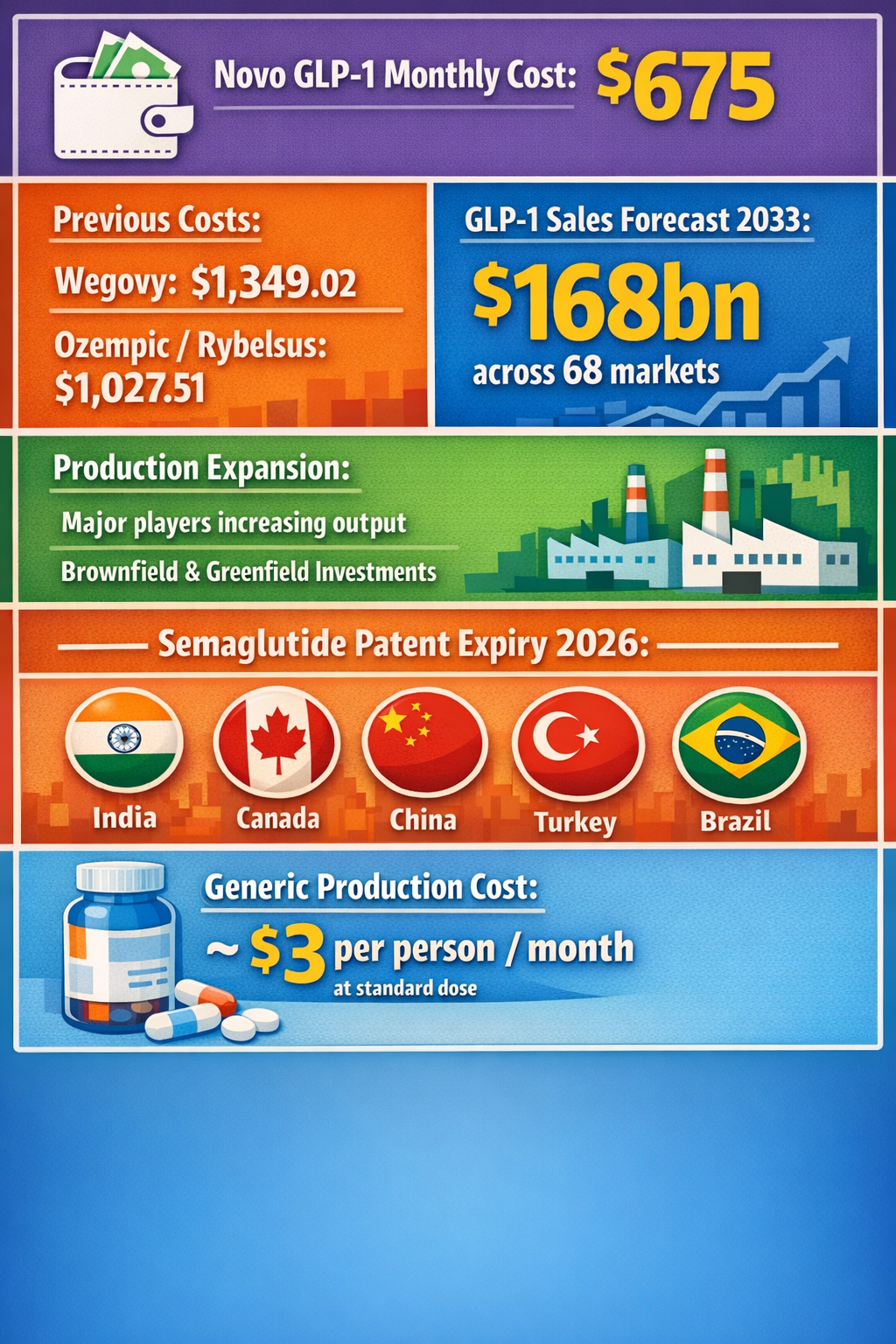
While this volume growth narrative is broadly anticipated, the inflection remains underappreciated: Indian manufacturers are beginning to flood markets with generic semaglutide copies, employing aggressive marketing and leveraging cost arbitrage advantages (Chemistry World 25/04/2026). Simultaneously, Novo Nordisk scheduled substantial list price reductions for GLP-1 molecules in 2027 (Yahoo Finance 29/04/2026), implicitly recognizing the necessity to pre-empt and adapt to generic competition and payer pressure. The alignment of these developments signals not mere pricing adjustments but a systemic recalibration of GLP-1 economics.
This price-volume inflection portends a shift from the current premium-biased market structure, constrained by high costs and limited accessibility, toward a mass-market model with wide oral therapy adoption and normalized longevity use. Compounding this is the FDA’s evolving stance on peptide-based drugs and oral delivery platforms (Gene Editing 101 10/04/2026), smoothing regulatory pathways toward more generics and biosimilars, which historically lag due to complex biologic manufacturing. The sum of these forces may irreversibly alter addiction points in healthcare capital spending and industrial concentration.
Disruption Pathway
The escalatory dynamic begins with accelerated adoption driven by enhanced patient access via Medicare coverage expansion and greater retailer pharmacy penetration (PR Newswire 29/04/2026). This surge in demand invites generic manufacturers, notably from India, to aggressively target global markets leveraging lower-cost oral semaglutide versions (Chemistry World 25/04/2026). As generics expand market share, incumbent premium pricing strategies become unsustainable, compelling brand owners to cut prices significantly, as Novo Nordisk plans for 2027 (Yahoo Finance 29/04/2026).
This price competition may induce payer cost containment—particularly beyond the US—pressuring national health systems to reassess reimbursement models and integrating GLP-1 drugs into broader obesity management protocols. The consequence could be a systemic shift in treatment algorithms with oral GLP-1 agents emerging as front-line obesity interventions, replacing or diminishing traditional lifestyle and surgical obesity therapies. Such diffusion may also incentivize development of next-generation GLP-1 molecules with enhanced efficacy or novel delivery mechanisms as differentiation strategies, broadening therapeutic pipelines.
An unintended consequence could be an exponential rise in off-label use or polypharmacy, stressing pharmacovigilance systems and demanding new regulatory oversight mechanisms for chronic mass treatments in non-diabetic populations. Additionally, incumbent manufacturers dependent on high-margin injectables might experience capital reallocation stress, potentially stimulating M&A, vertical integration in peptide manufacturing, or shifts into adjacent non-GLP-1 obesity fields that currently show limited investor interest (Pharmaceutical Technology 29/04/2026).
Why This Matters
The signal implies profound implications for capital deployment, particularly in pharmaceutical R&D and manufacturing. Investors may need to anticipate margin contractions in premium GLP-1 products and redirect capital toward scalable oral peptide manufacturing, generic biotech competitors, or integrated diabetes-obesity care platforms. Regulators and payers might confront pressure to revise coverage policies and develop frameworks for safely managing chronic population-level use of potent metabolic therapies.
Strategically, pharmaceutical incumbents face potential erosion of pricing power and market share, especially if generics from India aggressively expand beyond emerging markets. Supply chains may decentralize, with key peptide manufacturing hubs shifting geographically or technologically toward more flexible oral production. Simultaneously, medical liability and treatment guidelines could evolve as use cases diversify, necessitating new governance models balancing accessibility and safety.
Implications
This price-volume inflection could structurally transform the obesity drug industry landscape, heralding a democratization of advanced metabolic therapies that might realize sustained patient population growth beyond current projections. Market dynamics may shift from oligopolistic pricing to competitive accessibility, promoting healthier populations but challenging incumbent profitability. The transition is unlikely to be abrupt but could accelerate if emerging markets or payers demand lower costs and scaled access.
Critically, this development is not simply about a successful blockbuster drug or product line; it portends a systemic change in how obesity and diabetes therapeutics are industrially produced, priced, and regulated worldwide, potentially serving as a blueprint for future peptide-based chronic disease treatments. That said, some competing interpretations suggest longer-term proprietary biologics innovation will preserve incumbent profit pools; this signal challenges that orthodoxy by exposing vulnerabilities in pricing models and regulatory acceptance of oral generics.
Early Indicators to Monitor
- Volume and pricing trends of generic semaglutide launches in India and export markets
- Regulatory approvals and label expansions for oral GLP-1 peptide drugs beyond type 2 diabetes
- Capital flows in peptide manufacturing capacity expansion and generic pharma marketing investments
- Changes in payer reimbursement policies including Medicare expansions and global health system endorsements
- Pharmacovigilance reports indicating changes in chronic outpatient use patterns and off-label applications
Disconfirming Signals
- Failure of FDA or equivalent regulators to approve or expand oral GLP-1 drugs or delay in generic approvals
- Persistence of premium pricing models despite generic competition due to supply bottlenecks or manufacturing complexity
- Limited market uptake due to adverse effects, safety concerns, or poor adherence to oral peptide therapies
- Emergence of superior non-GLP-1 obesity drugs that disrupt investment patterns and payer preferences
- Restrictive payer policies curtailing broad coverage due to cost or liability concerns
Strategic Questions
- How should pharmaceutical companies realign R&D and manufacturing investments to navigate potential margin erosion from generic oral GLP-1 drugs?
- What regulatory frameworks and payer mechanisms will best balance rapid access with safety monitoring amid growing oral peptide adoption?
Keywords
GLP-1 drugs; oral peptide therapeutics; generic pharma competition; obesity drug market; regulatory policy innovation; healthcare reimbursement; pharmaceutical pricing
Bibliography
- The Medicare GLP-1 Bridge will be available nationwide across all states and territories... PR Newswire. Published 29/04/2026.
- Novo Nordisk is raising its forecast for 2026 as the weight-loss drug Wegovy is selling better than expected... Sweden Herald. Published 29/04/2026.
- GLP-1 therapies, developed by established players such as Eli Lilly and Novo Nordisk, are expected to achieve peak sales in 2026... Business 20 Channel. Published 05/05/2026.
- India's generic semaglutide surge... Chemistry World. Published 25/04/2026.
- Novo Nordisk is planning to drastically reduce the list prices of its popular GLP-1 treatments... Yahoo Finance. Published 29/04/2026.