
The Quiet Inflection: Geopolitical Fragmentation in Iran as a Catalyst for Regional Migration and Mobility Realignments
Emerging instability within Iran may not only trigger large-scale refugee movements but initiate a broader, underappreciated transformation in regional migration dynamics and economic structures over the next two decades.
The risk of Iranian state collapse and the ensuing power vacuum are often discussed in terms of immediate security threats. However, this signal also portends a profound shift with potential cascading impacts on migration corridors, regional economic integration, and regulatory frameworks governing cross-border mobility. This dynamic remains under-recognized despite its capacity to disrupt investment flows, national labor markets, and geopolitical alignments. Understanding this weak signal reframes migration not just as humanitarian fallout but as a structural factor influencing capital allocation and industrial strategy across Asia and the Middle East over the next 10–20 years.
Signal Identification
This development qualifies as an emerging inflection indicator, as it signals a potential systemic shift arising from geopolitical fragmentation and its demographic ripple effects. While instability in Iran and migration are known topics, the multidimensional nature linking state failure, sectarian conflict spillover, and migratory realignment remains poorly integrated into existing foresight narratives. The plausibility is assessed as medium to high over a 10–20 year horizon, dependent on political trajectories and conflict dynamics. The sectors exposed most directly encompass regional security, international migration governance, transnational labor markets, infrastructure planning, and multinational investment management.
What Is Changing
Multiple analyses emphasize the fragility of Iran's political landscape and the ramifications for migration flows. The possibility of state collapse risks not only direct refugee outflows to Pakistan and neighboring states but also fosters ethnic fragmentation producing sectarian tensions within host countries like Pakistan and Saudi Arabia (Al Jazeera Studies 23/03/2026; Eurasia Review 23/03/2026). This duality functions as a stress multiplier, accelerating displacement while fragmenting traditional migration routes and complicating regulatory responses.
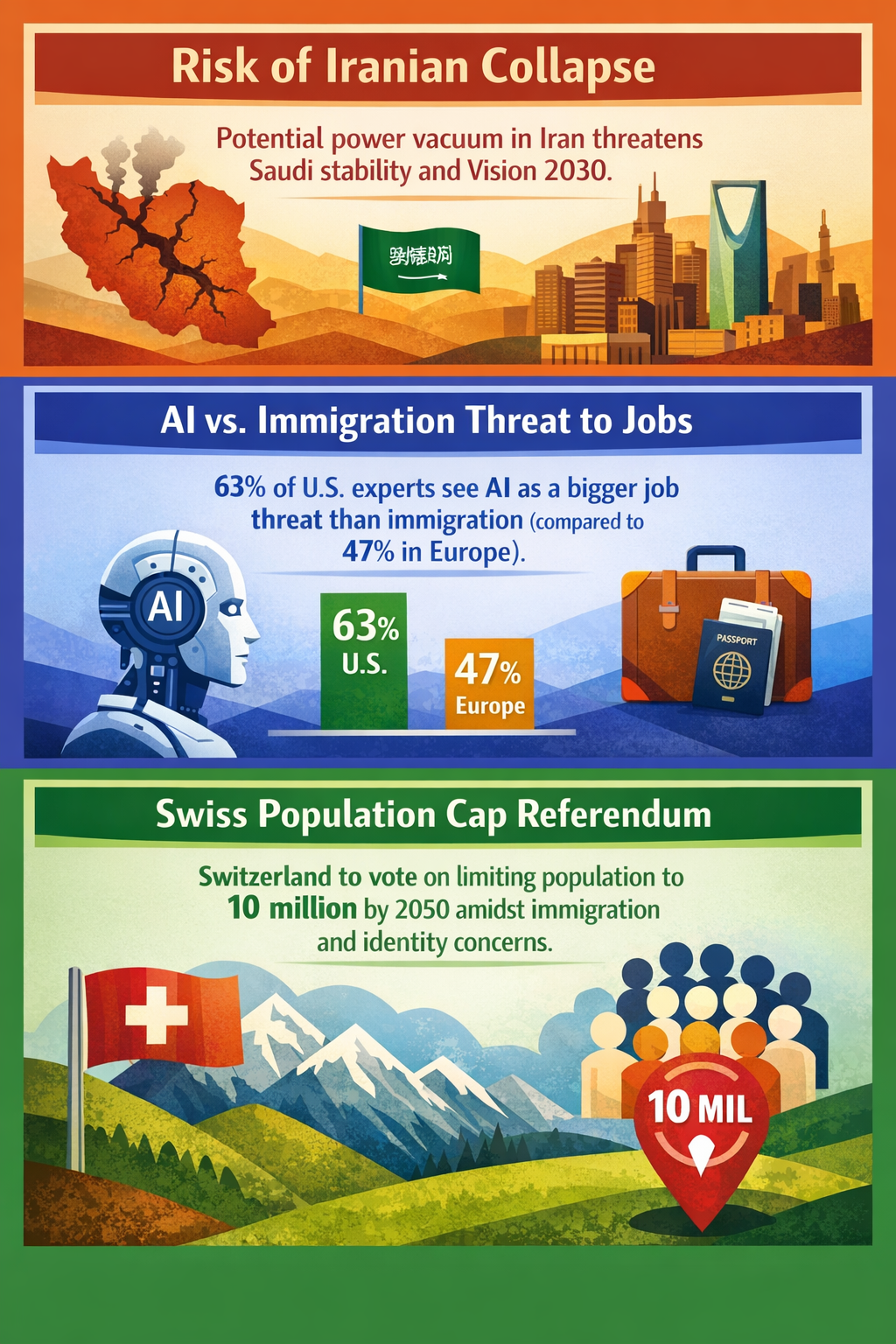
Concurrently, these developments intersect with broader global migration shifts, particularly climate-driven displacement in vulnerable regions of Africa and South America (Bkobog Substack 01/05/2026) and growing domestic opposition to immigration in developed countries, evidenced by Switzerland’s referendum proposing population caps motivated by immigration concerns (Money Control 27/04/2026). The Iranian case stands apart because it embodies a convergence of forced migration triggered by state fragility, ethnic realignments, geopolitical competition, and economic transformation agendas — notably Saudi Arabia’s Vision 2030, which itself risks disruption from spillover instability (Eurasia Review 23/03/2026).
This migration potential is underscored by the structural vulnerabilities of current host countries and refugee camps, where inadequate security and funding shortfalls exacerbate risks of onward displacement and illicit recruitment (Crisis Group 05/04/2026), thereby fracturing stable labor markets and complicating integration policies. The UK and U.S. contexts show how immigration policy oscillations — from restrictive stances to family-unity reforms — interact dynamically with demographic shifts and economic dependencies (CPA 27/04/2026; AILA 28/04/2026).
Disruption Pathway
Should Iranian state fragmentation intensify, refugee flows may surge unpredictably across Pakistan’s border, overwhelming infrastructure and weakening governance within border regions already sensitive to sectarian strife (Al Jazeera Studies 23/03/2026). This surge may precipitate a chain reaction: host countries facing political pressure might enact stricter border controls or population caps, as Switzerland considers, thereby disrupting labor markets dependent on migrant workers and constraining regional economic projects.
Investment climates in regions tied to Saudi Vision 2030 and broader Middle East economic diversification could reassess risks, leading to capital withdrawal or reallocation, eroding development trajectories (Eurasia Review 23/03/2026). This economic uncertainty may reinforce political fragmentation, creating feedback loops of instability and displacement.
On the governance side, mounting humanitarian pressures could catalyze stronger multilateral frameworks addressing migratory flows and protections but may also provoke nationalist retrenchment, as evidenced by Hungary's rise of far-right populism undermining migration-friendly policies (The Guardian 24/04/2026). This polarisation might fragment migration governance regimes further, encouraging patchwork regulatory landscapes marked by unilateral border enforcement and reduced cooperation.
Unintended consequences may include expanded informal economies exploiting migrant vulnerabilities, sustained cycles of conflict in host and origin countries, and long-term alteration of mobility corridors that bypass traditional hubs. This reconfiguration could challenge dominant industrial and geopolitical models, compelling sectors to rethink workforce sourcing, supply chain resilience, and geopolitical risk assessment.
Why This Matters
For decision-makers in capital markets and regulatory agencies, this evolving dynamic signals a potential realignment of risk profiles linked to migration-related instability. Infrastructure investments, particularly in border zones and refugee-hosting areas, may face increased volatility and require adaptive management strategies.
Regulators could confront a complex balance between humanitarian obligations and national security concerns, resulting in evolving legal frameworks around asylum, family reunification, and labor migration. Competitive positioning for industries dependent on migratory labor — agriculture, construction, and services — may need urgent recalibration, shifting from reliance on predictable migrant inflows to agile local labor development or automation.
Supply chains will be indirectly impacted by geopolitical fragmentation that disrupts trade corridors, especially in Southwest Asia, influencing logistics networks and commodity access. Liability exposures could rise in humanitarian and corporate sectors due to increased incidents of migrant exploitation, prompting tighter governance and compliance requirements.
Implications
This inflection may plausibly escalate into structural change affecting regional economic integration and international migration policy regimes. Long-term population caps, such as Switzerland’s referendum proposal, might signal a growing trend with global resonance, constraining migration-driven GDP growth demonstrated in the UK and elsewhere (CPA 27/04/2026).
The transformation differs from transient migration surges seen in prior crises due to its embeddedness in geopolitical fragmentation and ethnic realignments, amplifying complexity. Yet, competing interpretations exist: some analysts emphasize resiliency of migration corridors and humanitarian frameworks, betting on state and multilateral stabilisation, potentially mitigating worst-case outcomes.
This phenomenon might not primarily manifest as sudden mass displacement but as sustained, irregular migratory pressures reshaping local labor markets and bilateral relations over decades. Hence, it could disrupt current capital allocation norms and regulatory models incrementally yet profoundly.
Early Indicators to Monitor
- Escalation of sectarian conflicts and non-state actor activity along Iran’s borders
- Increased refugee registrations at Pakistan-Iran border crossing points with declining host country capacities
- Emergence of legislative proposals to cap populations or restrict immigration in OECD and Middle Eastern states
- Shifts in foreign direct investment (FDI) flows away from Saudi Vision 2030-linked sectors
- Policy moves toward tighter migration enforcement combined with humanitarian funding shortfalls in refugee camp administrations
Disconfirming Signals
- Rapid political stabilization in Iran with restored central governance and improved ethnic inclusion mechanisms
- Successful multilateral refugee management and integration frameworks reducing onward migration and mitigating host country tensions
- Reversal or abandonment of population cap proposals in key OECD nations
- Significant increase in resourcing for humanitarian and infrastructure capacity in border and camp regions
- Robust political consensus preventing nationalist retrenchment in countries heavily exposed to migration
Strategic Questions
- How should capital allocation strategies adjust to the risk of prolonged geopolitical fragmentation in key migratory source regions?
- What regulatory frameworks can balance national security concerns with the need to mitigate destabilizing population displacements across contiguous regions?
Keywords
Migration; Geopolitical Instability; Refugee Flows; Population Caps; Middle East; Migration Policy; Labor Markets; Capital Allocation; Humanitarian Crisis; Saudi Vision 2030
Bibliography
- Islamabad Opening: How Pakistan Became Washington And Tehran’s Key Mediator. Al Jazeera Studies. Published 23/03/2026.
- The Fault Lines Of A New Middle East: The 2025-2026 US-Israel-Iran War And The Reordering Of Regional Geopolitics. Eurasia Review. Published 23/03/2026.
- Executive Summary: 2026 Global Weather. Bkobog Substack. Published 01/05/2026.
- Is Switzerland Tightening Doors On Immigration? Inside The 10 Million Population Cap Plan And What It Means For Indians. Money Control. Published 27/04/2026.
- Global Watch List 2026 Spring Edition: Refugee Camp Security And Onward Migration Risks. Crisis Group. Published 05/04/2026.
- UK Business News Today: Economy, Markets, Insolvencies. CPA. Published 27/04/2026.
- Europe Profound State Of Crisis: Assess Threats & Remedy. The Guardian. Published 24/04/2026.
- National Day of Action: American Immigration Law Reform. AILA. Published 28/04/2026.