
The Underappreciated Impact of AI-Driven Smart Contract Self-Healing on Tokenised and Decentralised Finance
Artificial intelligence-enabled autonomous smart contract auditing and self-healing represent a critical but under-recognised inflection that could structurally reshape decentralised finance (DeFi) and tokenised assets. This signals a potentially transformative shift in operational risk management, regulatory oversight, and capital flow dynamics over the next decade.
While much of the current discourse around tokenised finance focuses on scaling, interoperability, and regulatory frameworks, the ascent of AI-powered “self-healing” smart contracts offers a paradigm shift in resiliency and trust. By enabling real-time vulnerability detection and patching without centralized intervention, this development could dismantle traditional notions of operational risk, alter regulatory approaches to compliance and auditing, and shift strategic positioning in financial infrastructure provision.
Signal Identification
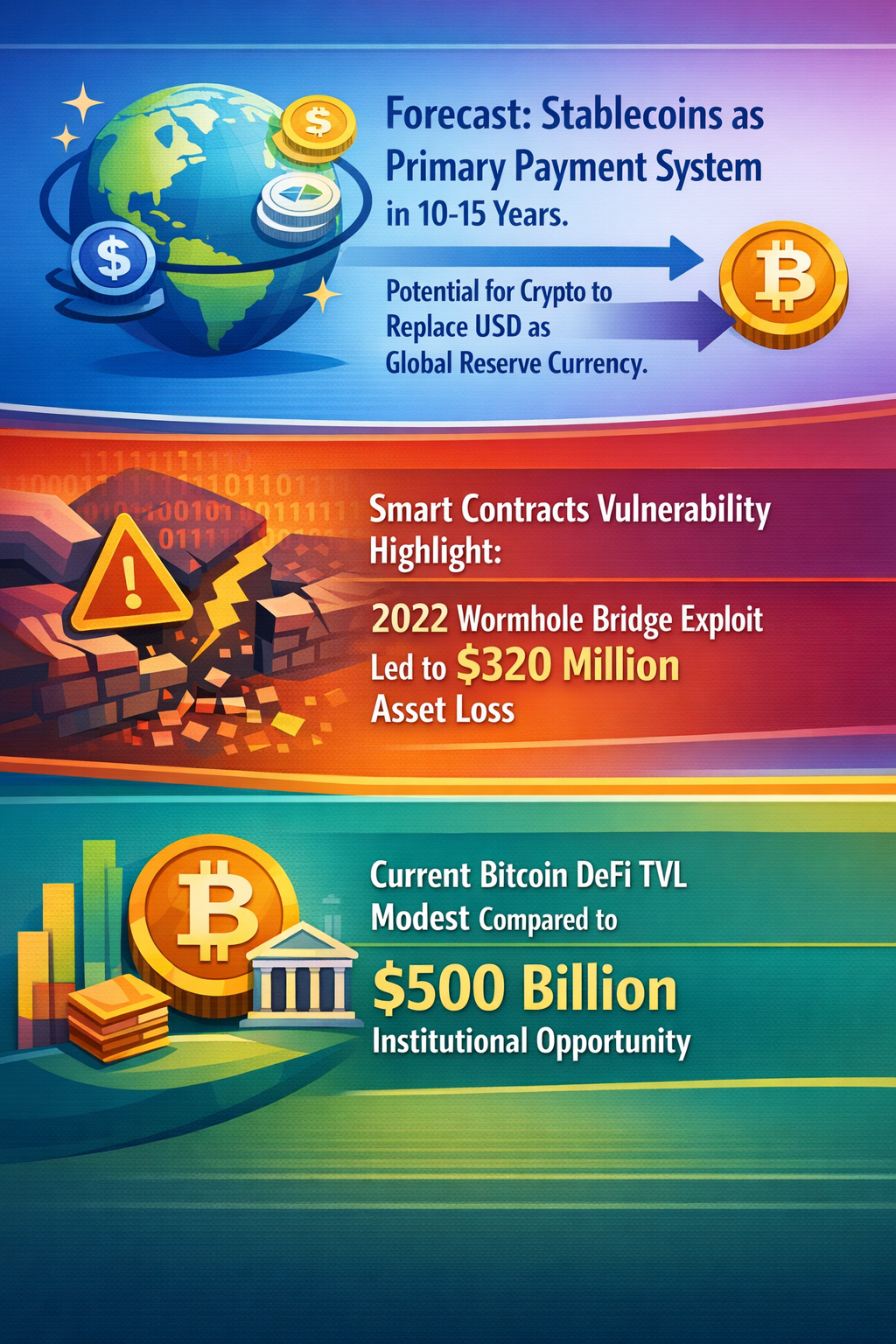
This development qualifies as an emerging inflection indicator. It reveals a systemic capacity evolution whereby decentralized protocols will, within 5–10 years, integrate AI agents that continuously audit their own codebases and governance frameworks to autonomously mitigate exploits and bugs (KuCoin Blog 19/04/2026). This differs sharply from current decentralized finance, which remains vulnerable to large-scale exploits, as exemplified by the 2022 Wormhole attack that caused $320 million in losses (MetaMask News 10/11/2025). The time horizon is medium (5–10 years), plausibility is medium-high given ongoing AI and blockchain integration trajectories, and critical sectors exposed include financial services, regulatory bodies, technology infrastructure providers, and cybersecurity firms.
What Is Changing
Decentralized finance has expanded rapidly, with total value locked (TVL) and institutional interest growing at a composite annual growth rate exceeding 40% projected between 2026 and 2030 (ReckonSys Blog 02/03/2026). Yet, fragility remains a structural constraint; the Wormhole breach underscored that smart contract vulnerabilities translate directly into multi-hundred-million-dollar losses, undermining investor confidence (MetaMask News 10/11/2025). Current security is largely reactive, relying on manual audits that lag behind emergent exploits (Purple Ops Blog 21/04/2026).
Emerging blockchain projects are integrating AI oracles and SDKs to enable real-time, autonomous security monitoring and governance updates (OpenPR News 12/04/2026). The vision is “self-healing” DeFi protocols that can detect, analyse, and patch vulnerabilities before attackers exploit them, significantly reducing systemic risk and increasing resilience (KuCoin Blog 19/04/2026). This could transform how capital is allocated to DeFi projects, as risk-adjusted returns become more predictable and incidents rare.
Simultaneously, regulatory frameworks such as the U.S. GENIUS Act for stablecoins emphasize reserve and disclosure systems but currently lack frameworks for AI-autonomous contract management (CoinPro Insights 01/04/2026). This gap suggests regulatory paradigms must evolve beyond prescriptive controls toward dynamic, AI-audited compliance models.
Disruption Pathway
The integration of AI-driven self-healing smart contracts is likely to accelerate through increasing investor demand for DeFi resilience, institutional adoption, and regulatory pressures to enhance security postures. Early triggers will include continued high-profile exploits and consequential capital flight, driving adoption of AI agents as a competitive differentiator.
This technology introduces stress to existing regulatory and operational frameworks that assume static, manual governance of smart contracts. Autonomous AI-led interventions erode traditional audit trails and human governance dominance, creating regulatory adaptation challenges around accountability and liability. As AI agents learn and act across decentralized governance layers, governance models may evolve into hybrid human-AI protocols with consensus around dynamic governance amendment.
These dynamics may prompt incumbent financial institutions and infrastructure providers to reposition as AI-security integrators oracles, or interoperation protocol gatekeepers. Feedback loops occur as improved security reduces the cost of capital entry for DeFi projects, attracting more institutional capital and increasing systemic complexity—placing further premium on AI oversight.
Ultimately, this could shift dominant industry players from custodial or centralized risk managers toward AI-managed decentralized infrastructures, fostering new ecosystems where operational resilience and trust are encoded autonomously.
Why This Matters
Strategic decision-makers must recognise that AI self-healing smart contracts could recalibrate risk valuation and regulatory compliance costs, thereby affecting capital deployment strategies and industrial positioning. The implications for governance are profound: entities that fail to integrate or oversee evolving AI-audited contract infrastructures risk obsolescence or liability exposure from uncontrollable autonomous behaviour.
The necessity to embed AI resilience tools into tokenised finance infrastructures will drive new supply chain dependencies on specialized AI blockchain security providers, potentially consolidating market power within those ecosystems. Regulatory frameworks may need redesigning to accommodate continuous, algorithmic compliance verification rather than periodic reporting, reshaping enforcement and supervision models.
Implications
This AI-driven self-healing could likely become a foundational infrastructure layer rather than a luxury add-on, thereby structurally reducing operational risk in DeFi and tokenised assets. Capital allocation might increasingly flow toward protocols with integrated autonomous security, incentivizing broader adoption (>40% CAGR) of such systems (ReckonSys Blog 02/03/2026).
It may also drive convergence between traditional finance and DeFi governance, with centralized entities seeking AI-enhanced transparency and continuous assurance from decentralized smart contracts (Yellow Research 15/03/2026). However, this is not guaranteed; competing interpretations might view AI autonomy as exacerbating uncontrollable risk vectors or regulatory uncertainty, thereby slowing adoption.
This development should not be conflated with incremental smart contract security improvements; the systemic impact emerges from continuous, autonomous governance and patching, a qualitative shift not yet mainstream in strategic assessments.
Early Indicators to Monitor
- Launch and adoption rates of AI oracle networks and SDKs that enable autonomous smart contract auditing.
- Venture funding concentration in projects integrating AI self-healing capabilities into DeFi protocols.
- Regulatory drafts or industry standards development addressing AI-assisted governance and smart contract compliance.
- Institutional investor disclosures or capital allocation shifts favoring AI-secured tokenized asset platforms.
- Incident frequency and scale of DeFi exploits decreasing in correlation with AI-based intervention adoption.
Disconfirming Signals
- Persistent inability of AI agents to effectively detect or patch emerging vulnerabilities leading to repeated, large-scale losses.
- Regulatory prohibitions or slowed approvals for AI autonomous contract management frameworks.
- Investor resistance due to increased perceived opacity or uncontrollability of AI-driven governance.
- Emergence of new exploit techniques that AI cannot counteract at scale.
- Stagnation in integration of AI oracles and SDKs in major DeFi ecosystems beyond pilot stages.
Strategic Questions
- How should capital allocations adapt to the emerging risk profiles of AI-augmented DeFi protocols versus traditional manual security models?
- What regulatory frameworks and governance models are required to ensure accountability and transparency of AI-managed decentralized finance contracts?
Keywords
Decentralised Finance; Smart Contracts; Artificial Intelligence; Self-Healing Systems; Tokenisation; Blockchain Security; Stablecoins; GENIUS Act; Regulatory Frameworks; AI Oracles
Bibliography
- The U.S. Securities and Exchange Commission (SEC) is refocusing on core enforcement priorities, while addressing emerging risks such as AI, cybersecurity and digital assets. IQ-EQ. Published 10/04/2026.
- Smart contracts can contain bugs or exploitable vulnerabilities - the 2022 Wormhole bridge exploit, for instance, resulted in the loss of $320 million in wrapped assets. MetaMask News. Published 10/11/2025.
- By 2030, DeFi protocols will be self-healing, with AI agents constantly auditing their own smart contracts and suggesting real-time patches to governance subnets like Bittensor. KuCoin Blog. Published 19/04/2026.
- The DeFi industry is growing at 43.3% CAGR between 2026 and 2030. ReckonSys Blog. Published 02/03/2026.
- The AI Oracle Network SDK and cross-chain bridges planned for Q2 2026 could open doors for developers building everything from predictive analytics in DeFi to optimized supply-chain solutions. OpenPR News. Published 12/04/2026.
- The GENIUS Act in the USA creates a nationwide framework for stablecoins and could further accelerate their everyday use. CoinPro Insights. Published 01/04/2026.